
A System Operating and Training Manual provides detailed operational and training information for process plant systems, including those found in oil and gas refineries, petrochemical plants, food processing facilities, and other complex industrial installations. It supports both experienced operators and trainee personnel, ensuring safe, consistent, and efficient operation of plant systems under normal, abnormal, and emergency conditions.

What This Manual Is For
This manual acts as a dual-purpose operational and training resource, explaining how each process system functions, how system equipment is controlled, and how operators must respond to various operating scenarios. It is structured to provide:
- Clear operating principles for each system
- Step-by-step operating procedures
- System design intent, boundaries, and hazards
- Detailed training material for new or transitioning operators
This is essential in processing environments where system interactions, safety logic, and control responses must be understood precisely.
Who It’s For
- Process operators (experienced and trainee)
- Control room technicians
- Operations supervisors
- Engineering support staff
- Training and competency teams
Why It Matters in Oil & Gas and Processing Plants
In hazardous, tightly regulated sectors such as refining, petrochemicals, gas processing, and food production a high-quality System Operating and Training Manual:
- Helps operators understand complex system behaviours
- Reduces the risk of process upsets or unsafe operating conditions
- Supports regulatory and corporate competency requirements
- Ensures operators correctly interpret alarms, setpoints, and shutdown logic
- Reinforces consistency across shifts and multi-discipline teams
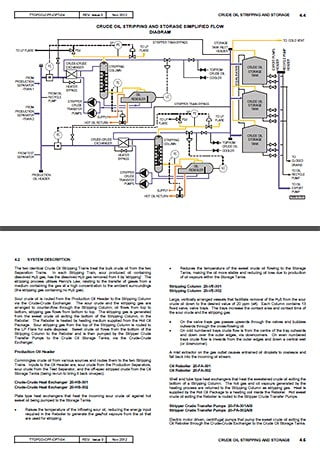
Typical Contents of a System Operating & Training Manual
Each manual is system-based and contains detailed information on all major process systems. The following structure is based directly on Orchid’s operating and training manual methodology.
1. INTRODUCTION
Defines the system boundaries, lists major equipment, describes system purpose, identifies system hazards, and states the objectives of the section. Supported by simplified system drawings.
2. SYSTEM DESCRIPTION
Provides an overview of the process system, describing what it does and the role each piece of equipment plays. Includes simplified drawings, and where needed, equipment cross-sections, skid layouts, and process diagrams.
3. EQUIPMENT LOCATION
Shows equipment location plans with system equipment highlighted. Includes tables of major equipment and key operating parameters—vital in large processing plants and refinery layouts.
4. OPERATING PRINCIPLES & PROCEDURES
Explains how the system functions and how it must be operated. Supported by P&IDs, SLDs, valve position tables, and detailed step-by-step operating instructions for different modes and conditions.
Typical refinery/gas plant scenarios include:
- Unit startup
- Unit shutdown
- Changeover between redundant equipment
- Load/throughput adjustments
- Purging, inerting, isolation, and reinstatement
5. SYSTEM PARAMETERS
Tables of operating setpoints, alarms, trips, and PSV settings—critical for high?integrity process systems in hazardous industries.
6. SYSTEM MONITORING & CORRECTIVE ACTIONS
Fault statements and the operator actions required to recover or stabilise the system, often based on Cause & Effect (C&E) charts or SAFE charts.
7. SPECIAL PROCEDURES
Covers non-routine system tasks not included in normal operating principles—examples include catalyst changeovers, filter replacement, tower packing replacement, mode transitions, unusual shutdown activities, or equipment bypass conditions.
8. INTERFACES WITH OTHER SYSTEMS
Details the connections and dependencies with upstream, downstream, and utility systems—especially important in refineries where system coupling is strong (e.g., feed systems, steam networks, flare systems, cooling water, nitrogen systems).
9. EQUIPMENT DETAILS
Detailed tables of equipment specifications, operating data, and performance parameters.
10. HAZARDS, SYSTEM SAFETY & ENVIRONMENTAL
Describes risks associated with system operation—personnel hazards, equipment hazards, environmental considerations, and how system shutdown philosophies apply.
Applicable Standards
The Standard that are applicable are industry dependent. However, the following may apply:
- ISO / IEC / IEEE 82079-1 – Preparation of Information for Use
- ISO 20607 – Safety of Machinery: Instruction Handbook
- ISO 12100 – Safety of Machinery: Risk Assessment and Risk Reduction
- ISO Technical Product Documentation Standards (ISO 01.110 Series)
How We Work
Orchid develops Operating and Training Manuals by:
- Capturing detailed information from engineering teams, P&IDs, SLDs, and system designers
- Structuring content so it serves both operations and training functions
- Producing diagrams, simplified system overviews, equipment layouts, and operating procedures
- Ensuring clarity, technical accuracy, and alignment with plant-specific standards
- Supporting the documentation needs of complex process systems in refineries, gas plants, petrochemical installations, and energy facilities
This approach has been applied across multiple oil & gas and industrial projects.
Delivery Options
- Print or digital PDF
- Controlled, revision-managed digital manuals
- Web-hosted or secure intranet versions
- Multilingual editions
Next Steps
To discuss a System Operating and Training Manual tailored to your process plant’s systems—or to request a quotation—please contact the Orchid team via our standard enquiry channels.
Other Manual Types can be seen here.